Tirzepatide against semaglutide
Two direct trials, two populations, and different semaglutide comparisons. The larger weight change is easier to understand with that context attached.
The obesity comparison
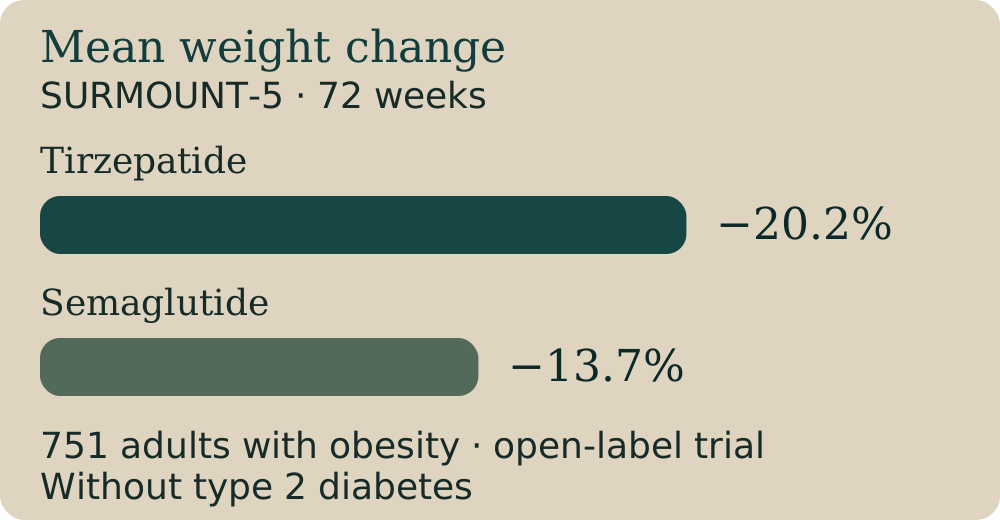
The SURMOUNT-5 trial compared tirzepatide with semaglutide in 751 adults with obesity without type 2 diabetes. At 72 weeks, mean weight change was -20.2% with tirzepatide and -13.7% with semaglutide. The difference was statistically significant.
Participants received the maximum tolerated trial doses, and the study was open-label: people knew which medicine they received. That knowledge can influence eating, expectations and symptom reporting. It leaves a limitation alongside a substantial measured difference in body weight.
The setting rescued this comparison from a slogan for me. “More powerful” compresses several questions into an adjective. This trial gives a definite answer about average weight change in this population, over this period.
The earlier diabetes comparison
The SURPASS-2 trial was an open-label, 40-week study of 1,879 adults with type 2 diabetes. It compared tirzepatide with semaglutide 1 mg. That semaglutide amount was used for diabetes, below the higher amount used for weight management.
HbA1c, the blood measure of average glucose over time, fell by 2.01, 2.24 and 2.30 percentage points across the tirzepatide groups, compared with 1.86 percentage points with semaglutide. Weight reductions also favoured tirzepatide, with treatment differences of -1.9, -3.6 and -5.5 kg.
I would file these results under diabetes comparisons. SURMOUNT-5 answers the later obesity question with a different design. The distinction prevents an older comparison from silently acquiring the meaning of the newer one. The 1 mg figure describes the comparator in a supervised trial; it offers no personal dosing guidance.
Two receptors and a placebo trial
Tirzepatide is a synthetic peptide built around the GIP hormone sequence. It activates both GIP and GLP-1 receptors, whereas semaglutide activates GLP-1 receptors. These gut-hormone systems help regulate insulin, glucagon, appetite and stomach emptying; the clinical-reference chapter describes the dual action.
The SURMOUNT-1 trial placed tirzepatide against placebo in 2,539 adults with obesity or overweight and a weight-related complication, without diabetes. Mean weight changes at 72 weeks were -15.0%, -19.5% and -20.9% across the tested tirzepatide groups, compared with -3.1% with placebo. Patients and staff were blinded to the assignments.
Gastrointestinal effects were the most common adverse events, generally mild or moderate and concentrated during dose escalation. That is a recurring cost in these studies. The receptor design is clever; I judge its usefulness through the measured benefit and the burden together.
Pancreas, gallbladder and practical cautions
The review of nine randomised trials involving 9,871 people examined pancreatitis and gallbladder or biliary disease. The pancreatitis estimate did not show a statistically significant increase and remained compatible with uncertainty in either direction. The combined gallbladder-or-biliary-disease outcome was significantly higher; individual components were not significantly increased on their own.
The label warns about thyroid C-cell tumours on the basis of rodent data and excludes people with a personal or family history of medullary thyroid carcinoma or MEN-2. Human thyroid risk remains unconfirmed. Insulin and sulfonylureas can increase the risk of low blood sugar when used with tirzepatide. Persistent vomiting or diarrhoea can cause dehydration and kidney injury.
Slower stomach emptying can alter absorption of oral medicines, including hormonal contraceptives, and can leave retained stomach contents around anaesthesia. The clinical team needs the complete medication history when planning treatment or procedures. Loss of lean tissue and weight regain after stopping also matter to the longer course of treatment.
Community accounts mention quieter food thoughts, easier movement and better sleep, as well as nausea, constipation, diarrhoea, taste changes, fatigue and hair shedding. They are anecdotal observations, not clinical evidence that establishes a cause. Enthusiasm supplies no estimate of a typical response.
Approval history
The first US approval covered type 2 diabetes in May 2022; the reference chapter records that initial indication. Chronic weight management followed in November 2023, with moderate-to-severe obstructive sleep apnoea in adults with obesity added later. Approved formulations require a prescription. Compounded preparations are not FDA-approved.
Tirzepatide is not specifically prohibited by the World Anti-Doping Agency in the records discussed here; current sports rules still require checking. The FDA history here concerns the United States. It leaves Health Canada's present position to current Canadian records.